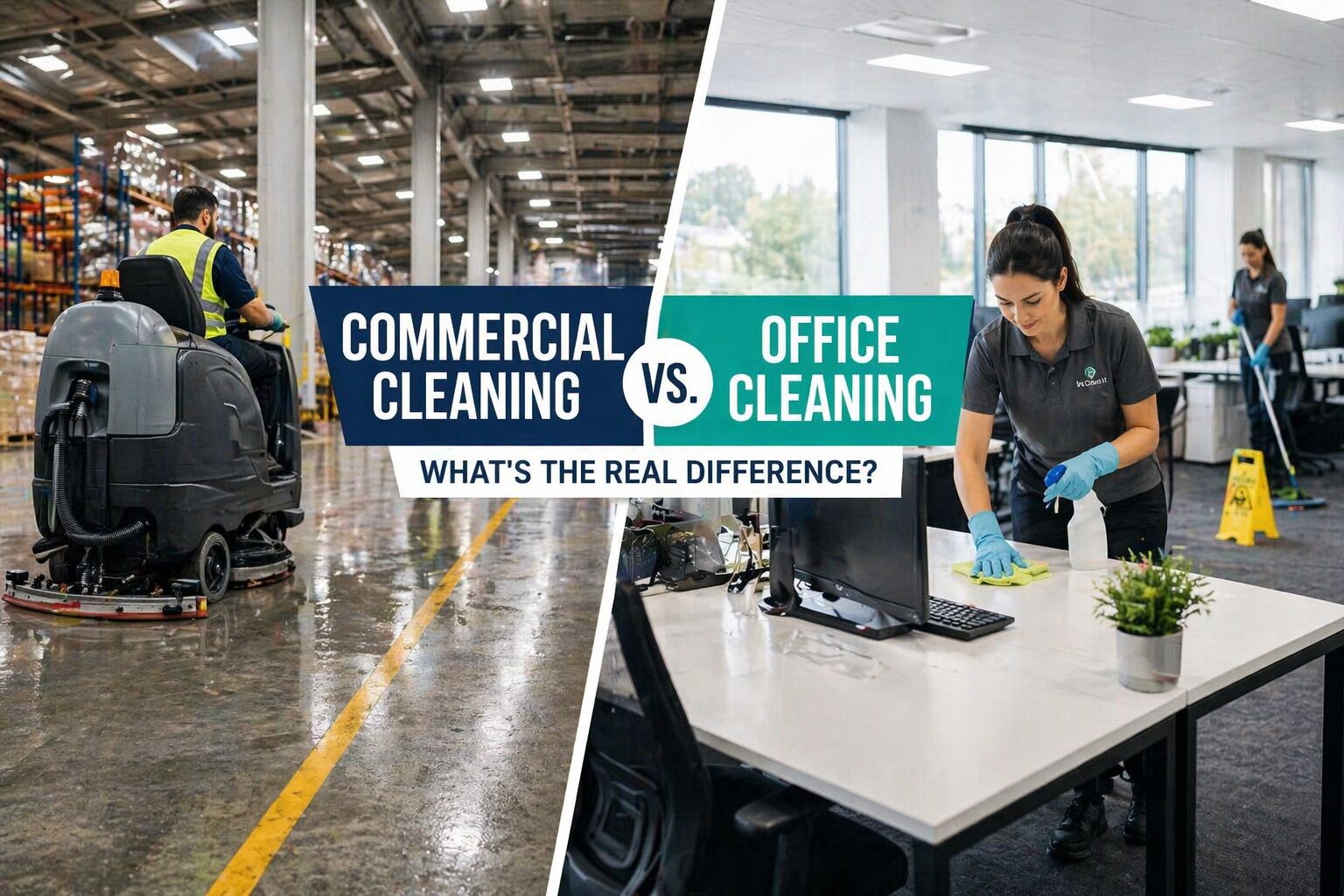
Most people use “commercial cleaning” and “office cleaning” interchangeably, but they’re actually not the same thing. Understanding the distinction helps you choose the right service, get an accurate quote, and make sure your space is cleaned to the standard it actually requires.
First Things First: Defining Each Term
The confusion between commercial cleaning and office cleaning is understandable; both happen in professional environments, both involve trained cleaners, and both share many common tasks. But the scope, complexity, and specialisation involved in each are quite different.
Think of it this way: office cleaning is a subcategory of commercial cleaning. All office cleaning is commercial cleaning, but not all commercial cleaning is office cleaning.
Commercial cleaning refers to any professional cleaning service carried out on a business premises. It is the umbrella term, broad, varied, and shaped entirely by the industry and environment it serves. Office cleaning sits within that umbrella, but it is just one type among many.
What Falls Under the Commercial Cleaning Umbrella
Commercial cleaning covers an enormous range of environments and service types. Here is a detailed breakdown of what sits under that umbrella:
Industrial and warehouse cleaning
This covers factory floors, production lines, loading docks, storage areas, and heavy machinery. This type of cleaning typically requires industrial-grade equipment such as ride-on scrubbers, pressure washers, and solvent-based degreasers. Safety is a major consideration; cleaners working in these environments must understand how to operate around hazardous materials, heavy equipment, and potentially dangerous surfaces.
Healthcare and medical facility cleaning
This is one of the most regulated and specialised areas of commercial cleaning. Hospitals, GP surgeries, dental practices, and care homes all require hospital-grade disinfectants, strict infection control protocols, and compliance with NHS or CQC guidelines. Cross-contamination prevention is critical, and cleaners are trained specifically for clinical environments where the consequences of poor hygiene can be serious.
Restaurant and hospitality cleaning
This goes far beyond what most people imagine. Commercial kitchens accumulate grease at a rapid rate, and regular deep cleaning of cooking equipment, extraction hoods, exhaust ducts, grease traps, and kitchen surfaces is not just good practice, it is a legal requirement under food safety law. Front-of-house cleaning in restaurants, hotels, and bars also demands fast turnaround, often between service periods or overnight.
Retail and shopping centre cleaning
This handles the challenges of high footfall, public-facing presentation, and fast turnaround. This includes floor maintenance across large surface areas, window cleaning, fitting room upkeep, escalator and lift cleaning, and waste management. Retail cleaning often happens overnight or in the early hours to avoid disrupting customers.
Educational facility cleaning
This covers schools, colleges, and universities, environments that see heavy daily use from large numbers of people. Cleaning must address classrooms, corridors, toilets, canteens, sports halls, and outdoor areas. Scheduling is carefully managed around term times, and deep cleans are often carried out during school holidays.
Leisure and gym facility cleaning
This covers fitness centres, swimming pools, changing rooms, and sports facilities. These environments carry a higher risk of bacterial and fungal spread due to moisture and body contact with surfaces, so appropriate disinfectants and cleaning frequencies are essential.
External and communal area cleaning
In a commercial setting this includes car parks, building exteriors, communal stairwells, lobbies in apartment blocks, and shared spaces in business parks. Jet washing, litter picking, and window cleaning at height all fall into this category.
We also offer communal area cleaning in a domestic setting.
Carpet and upholstery cleaning
At a commercial scale, this is done using hot water extraction or dry cleaning methods. It is also a distinct service within the commercial cleaning umbrella, applied across offices, hotels, cinemas, and public buildings.
If you’re looking for carpet and upholstery cleaning in a domestic setting, we offer this under our carpet cleaning and domestic cleaning services.
Post-construction cleaning
Post-construction and builders’ clean is a specialist service carried out after renovation or new-build work. It involves the removal of construction dust, plaster residue, adhesive, paint splatter, protective film from windows and surfaces, and general building debris. It often requires multiple stages — a rough clean, a detailed clean, and a final sparkle clean before handover.
Additionally we also offer post-construction cleaning for domestic sites.
Finally, specialist one-off cleans such as after-flood cleaning, trauma cleaning, or deep sanitisation following an illness outbreak are also firmly in commercial cleaning territory, requiring additional training and, in some cases, personal protective equipment.
What Is Included in Office Cleaning
Office cleaning is more defined and consistent in its scope. While the size of the office and the frequency of cleaning will vary, the tasks involved are largely the same from one client to the next.
Workstation and desk cleaning
The core of any office clean. This includes wiping down desk surfaces, computer monitors, keyboards, mice, telephones, and any other equipment on the desk. Products used must be appropriate for electronics, avoiding moisture damage or residue that could interfere with equipment. Attention is paid to high-touch points like door handles, light switches, and shared equipment such as printers and photocopiers.
Meeting rooms and boardrooms
These are cleaned thoroughly, tables wiped down, chairs tidied, whiteboards cleaned if requested, and floors vacuumed or mopped. Glassware or crockery left in meeting rooms is typically removed and surfaces are reset ready for the next use.
Reception and lobby areas
These areas are often the first thing a visitor sees, so presentation standards are high. Desks, seating areas, coffee tables, and any display materials are kept clean and tidy. Hard floors are mopped and carpeted areas are vacuumed. Glass doors and partitions are wiped to remove fingerprints and smears.
Kitchen and break room cleaning
An important part of any office clean. This covers wiping down all countertops and appliances, microwaves, kettles, toasters, and the outside of fridges. Sinks are cleaned and sanitised, bins are emptied and relined, and the general area is left hygienic and tidy. Some contracts include cleaning the inside of fridges on a weekly or monthly basis.
Toilet and bathroom cleaning
This covers all sanitary fittings, toilets, urinals, sinks, taps, and hand dryers. Mirrors are cleaned, floors are mopped, and consumables such as toilet paper, hand soap, and paper towels are restocked. Bins are emptied and relined. These areas are typically given the most attention in terms of disinfection.
Floor cleaning and care
Floor care is carried out throughout the office, vacuuming carpeted areas, mopping hard floors with appropriate products, and spot-treating any stains. Entrance mats are shaken or vacuumed, depending on the type.
Waste management
This involves emptying all desk-side bins, general waste bins, recycling stations, and confidential waste bins where applicable. Bins are relined and waste is taken to the appropriate collection point.
Window and glass cleaning
This includes internal, partition glass, internal windows, and glass doors, and is often included or available as an add-on. External window cleaning is usually a separate arrangement.
Some office cleaning contracts also include periodic deep cleaning tasks carried out less frequently, such as carpet cleaning, upholstery cleaning on office chairs, descaling of kitchen appliances, cleaning of air conditioning vents, and a thorough clean of storage areas.
Scheduling and Timing
Office cleaning is almost always structured around business hours. Cleaners typically arrive early in the morning before staff, in the evening after everyone leaves, or during lunch for lighter maintenance. Consistency matters; many clients use the same team on a fixed schedule, allowing cleaners to become familiar with the layout, preferences, and security procedures.
Commercial cleaning in other sectors may operate around the clock. A hospital needs cleaning throughout the day, every day. A restaurant needs its kitchen deep-cleaned after closing. A factory may require weekend shutdowns for thorough floor and equipment cleaning. The scheduling is driven entirely by operational needs and, in many cases, regulatory requirements.
Equipment and Products
Office cleaning keeps things relatively simple — professional-grade vacuums, ergonomic mops, colour-coded microfibre cloths to prevent cross-contamination between areas, and appropriate surface sprays. Products are chosen to be safe around electronics, upholstered furniture, and people working nearby.
Commercial cleaning in specialist environments requires substantially more. Pressure washers, industrial steam cleaners, wet-dry vacuums, floor scrubbers, aerial work platforms, and chemical dosing systems may all be required, depending on the site. Products must often meet specific regulatory standards, hospital-grade disinfectants, food-safe degreasers, and industrial solvents are very different from what goes into a standard office spray bottle. Using the wrong product in a commercial environment is not just ineffective; it can be a compliance issue.
Pricing: What to Expect
We price office cleaning based on the size of the space, the frequency of visits, and any additional tasks required. Because the scope is predictable, our quotes are usually quick and reliable.
Commercial cleaning pricing is far more variable. A basic retail store clean is a very different proposition in cost from an industrial kitchen deep clean or a post-construction clearance. Specialised equipment, compliance requirements, team size, after-hours or weekend rates, and the complexity of the work all factor into the price. Reputable commercial cleaning companies will always carry out a site assessment before providing a quote.
Which One Do You Actually Need?
If you operate from a standard office, whether it’s a small suite, a corporate floor, or a coworking space, office cleaning is precisely what you need. It’s reliable, consistent, and designed for your environment.
If your business operates from a specialised facility, a medical practice, industrial unit, restaurant, school, gym, or retail store, you need a commercial cleaning provider who understands your industry, the compliance landscape, and the specific demands of your space.
Getting this wrong has real consequences. Hiring a general office cleaner for an industrial site means they may lack the training, equipment, or insurance required. Conversely, paying for full commercial cleaning rates when all you need is a tidy office a few times a week is simply an unnecessary expense.
Here at We Clean It, Reggie and Louis have built the business on doing things the right way, assessing every site before work begins, recommending only what is actually needed, and delivering a consistent standard across Nottinghamshire whether it’s a small office suite or a large commercial facility. If you’re not sure which service is right for your space, get in touch and we’ll point you in the right direction.